
.png)
Cord vs. Half Cord Firewood: Choosing the Right Volume for Your Home

A loose pile of wood in your driveway isn't a measurement. It's a guessing game. You shouldn't have to wonder if you were shorted when the delivery truck leaves. It is a common frustration for Central Coast homeowners trying to weigh the pros of cord vs half cord firewood before the first frost hits. You need a reliable source of heat. You don't need a storage headache or a light load.
We understand that firewood math feels complicated. This guide simplifies the process. You will learn the exact dimensions of standard firewood units and how to calculate your home's seasonal needs. We will also cover storage footprints and why professional stacking is the only true guarantee of volume. By the end, you'll know exactly how much seasoned oak your hearth requires for a comfortable, worry-free winter.
Table of Contents
Understanding Firewood Measurements: The 128 Cubic Foot Standard
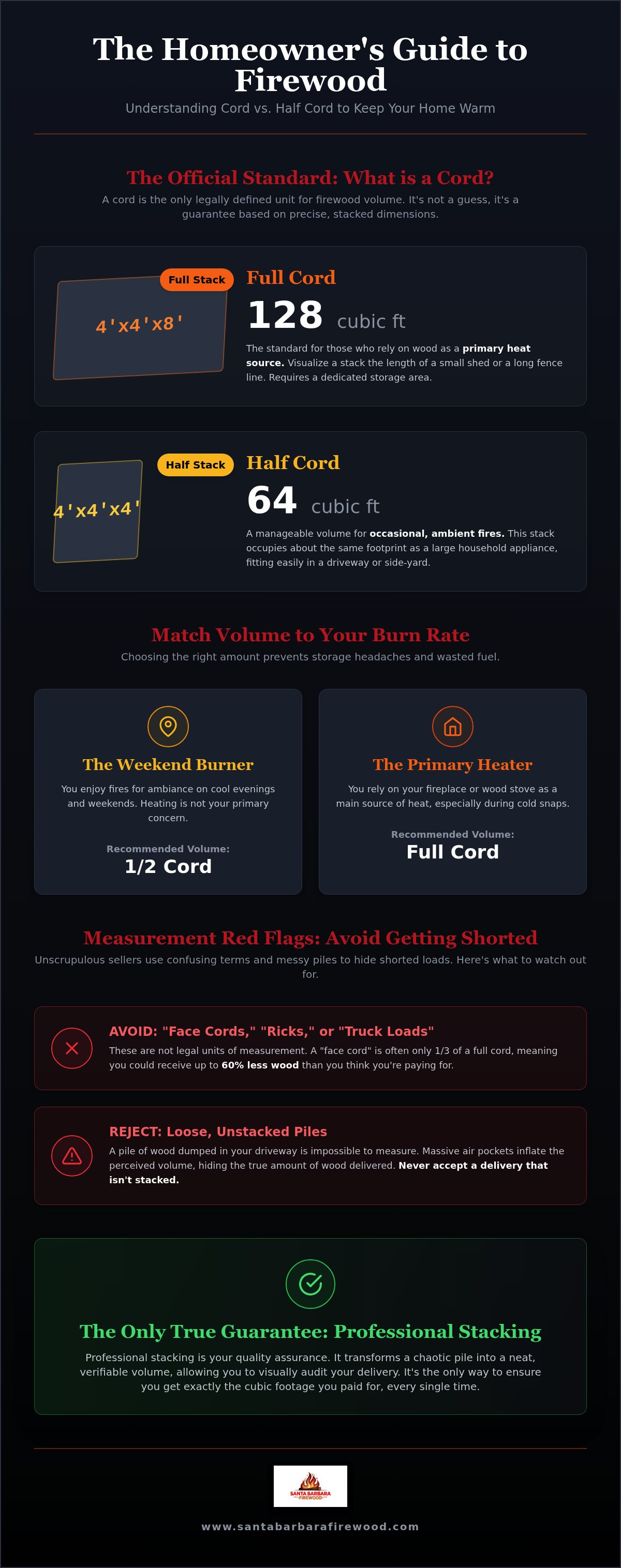
Firewood volume is defined by the official measurement of a cord. This unit represents exactly 128 cubic feet of wood. To reach this number, the logs must be stacked tightly. A standard full cord measures 4 feet high, 4 feet deep, and 8 feet wide. When weighing the value of cord vs half cord firewood, remember that loose wood in a truck bed is not a reliable metric. It lacks the density required for an honest measurement.
Accuracy requires density. The "air space" rule is simple. Logs should be parallel and packed with minimal gaps. This ensures you aren't paying for empty air. A half cord is exactly 50% of a full cord's volume, totaling 64 cubic feet. It typically measures 4 feet high, 4 feet deep, and 4 feet wide. Understanding the difference between a cord vs half cord firewood starts with these raw dimensions.
Full Cord vs. Half Cord: A Visual Comparison
A full cord is a substantial amount of fuel. Its footprint is 8 feet long. Visualize a long fence line or the side of a small garden shed. This volume is best for those with dedicated outdoor storage areas. It requires a clear, level space that can support significant weight. Most standard firewood racks are designed to hold either a full or half unit of wood.
The 1/2 Cord Oak option is more manageable for many Central Coast homes. It fits neatly into suburban driveways or narrow side-yards. At 4 feet wide, it occupies about the same space as a large household appliance. This size is ideal for homeowners who want a steady supply of heat without surrendering their entire patio to a wood stack.
Cord vs. Half Cord: Which Volume Matches Your Burn Rate?
Selecting between a cord vs half cord firewood delivery depends entirely on your consumption habits. Don't over-order if you only light the hearth for Saturday night ambiance. For the "Weekend Burner," a half cord or even a 1/4 cord is the most practical choice. These smaller volumes provide enough seasoned oak for occasional use throughout the season without requiring a massive storage footprint.
The "Primary Heat" profile requires a different strategy. In inland areas like Santa Ynez or Ojai, temperatures drop significantly. Homeowners using oak as their main heat source should opt for a full cord. High-density Live Oak is the preferred fuel for these environments. It burns longer and generates more heat than softwoods. This efficiency means fewer trips to the woodpile during a cold snap.
Storage Requirements for Santa Barbara Homes
Proper storage is essential for maintaining wood quality on the Central Coast. Coastal humidity can quickly lead to moisture buildup if wood is left in a heap. Stack your logs in a sunny area with plenty of airflow. Keep the pile elevated to prevent ground moisture from rotting the base. You can find more specific advice in our Central Coast winter checklist.
Density matters for storage efficiency. Live Oak is one of the heaviest hardwoods available. It packs more thermal energy into every cubic inch. It's a cleaner, more compact solution for modern homes. You need less physical space to store the same amount of heat compared to species like pine or fir. If you are ready to prepare your hearth, consider our seasoned oak delivery to ensure a warm winter.
The Truth About Face Cords and Verification Scams
Avoid non-standard terms like "rick" or "face cord" when ordering fuel. These are not legal units of measurement in most jurisdictions. A face cord typically represents only one-third of the volume of a full cord, yet customers often pay premium prices for it. This confusion leads to homeowners receiving up to 60% less wood than they actually expected. When comparing cord vs half cord firewood, you must stick to the cubic foot standard of 128 or 64 respectively. This is the only way to ensure a fair transaction and a warm home.
Never accept a measurement based on a loose pile dumped in your driveway. A heap of logs contains massive, irregular air pockets that inflate the perceived volume. It is a common tactic used by unscrupulous vendors to hide shorted loads. Without a tight, organized stack, you simply cannot verify if you received the volume you purchased. Professional stacking is the only way to eliminate this guessing game and provide peace of mind. It turns a delivery into a documented transaction.
Why Professional Stacking is Your Measurement Guarantee
At Santa Barbara Firewood, we eliminate the uncertainty of delivery day. We stack every order so you can visually audit the volume before we leave. Professional stacking transforms a chaotic pile into a verifiable volume, ensuring you get exactly 128 or 64 cubic feet of oak. This approach provides the transparency you deserve and proves our commitment to quality. You can learn more about our premium standard for firewood delivery with stacking. Stacking is the physical proof that your choice between cord vs half cord firewood was a sound investment.
Secure Your Winter Fuel Supply
Choosing between a cord vs half cord firewood delivery doesn't have to be a guessing game. You now have the tools to measure volume accurately and identify common measurement scams. Remember that a true cord is exactly 128 cubic feet of tightly packed wood. Professional stacking is the only way to verify you received what you paid for. It protects your investment and your home's comfort.
We've served Santa Barbara and Ventura since 2020 with a commitment to transparency. Every order of our premium seasoned Live Oak is hand-stacked for measurement accuracy. Stop worrying about loose piles and empty promises. Order your seasoned oak by text or online; delivery and stacking included. Prepare your hearth today for a warm and reliable winter season ahead.
Frequently Asked Questions
What are the dimensions of a 1/2 cord of firewood?
A half cord measures exactly 64 cubic feet. It's typically stacked in a block 4 feet high, 4 feet deep, and 4 feet wide. This compact footprint is ideal for Santa Barbara side-yards. It provides a substantial amount of seasoned oak without overwhelming your storage space. Professional stacking ensures these dimensions are met precisely for every Central Coast delivery we provide.
How much is a cord of firewood compared to a face cord?
A full cord contains 128 cubic feet of wood. A face cord isn't a legal unit; it usually represents a single row of logs 4 feet high and 8 feet wide. A face cord is often only one-third of a full cord. When weighing the value of cord vs half cord firewood, stick to official cubic measurements to avoid getting shorted by local vendors.
How many loads is a half cord of wood in a pickup truck?
One load is usually enough. A half cord generally fills a standard 8-foot pickup truck bed to the top of the rails. Short-bed trucks or smaller pickups require multiple trips to move the same volume. Loose piles in a truck bed are deceptive due to large air gaps. We recommend professional delivery and stacking in Ventura to confirm you receive the full 64 cubic feet.
Will a full cord of wood fit in a standard SUV?
It won't fit. A full cord occupies 128 cubic feet. Most large SUVs offer less than 100 cubic feet of total cargo space with all seats folded. Additionally, a full cord of seasoned oak weighs between 3,500 and 5,000 pounds. This significantly exceeds the payload capacity of passenger vehicles. Delivery is the only safe, efficient option for Santa Ynez or Ojai homeowners.


Comments